share this article
Sulfites (or sulfur dioxide, SO₂) are compounds naturally present in wine.
They can be :
Their main role is to stabilize and preserve wine.
They prevent the wine from oxidizing (avoiding a “maderized” taste).
They protect the wine from undesirable bacteria and yeasts.
They ensure better preservation over time.
Without sulfites, a wine can quickly :
In the doses used in wine, sulfites are considered safe by the health authorities.
By way of comparison :
Approximately 1% of the population may be sensitive to sulfites:
Possible symptoms:
But be careful:
In most cases, wine-related headaches are due to :
Although sulfites have been used in winemaking for centuries, they have become a source of distrust for many consumers. But this bad reputation is often based more on perception than fact.
The word “sulfites” can be frightening. It evokes something chemical, industrial, even artificial. But this is a misleading shortcut.
Sulfites are naturally produced during wine fermentation. Even a wine with no added sulfites still contains a small amount.
This confusion feeds the idea that all sulfites are “added” and therefore potentially harmful, which is false.
Sulphites are regularly blamed for wine-related headaches. But in most cases, sulfites are not the culprit.
The most frequent causes are :
True sulfite sensitivities do exist, but they remain in the minority.
For most consumers, sulfites pose no problem.
Rather than trying to avoid them altogether, some winemakers choose not to add them at all, by working differently right from the vine.
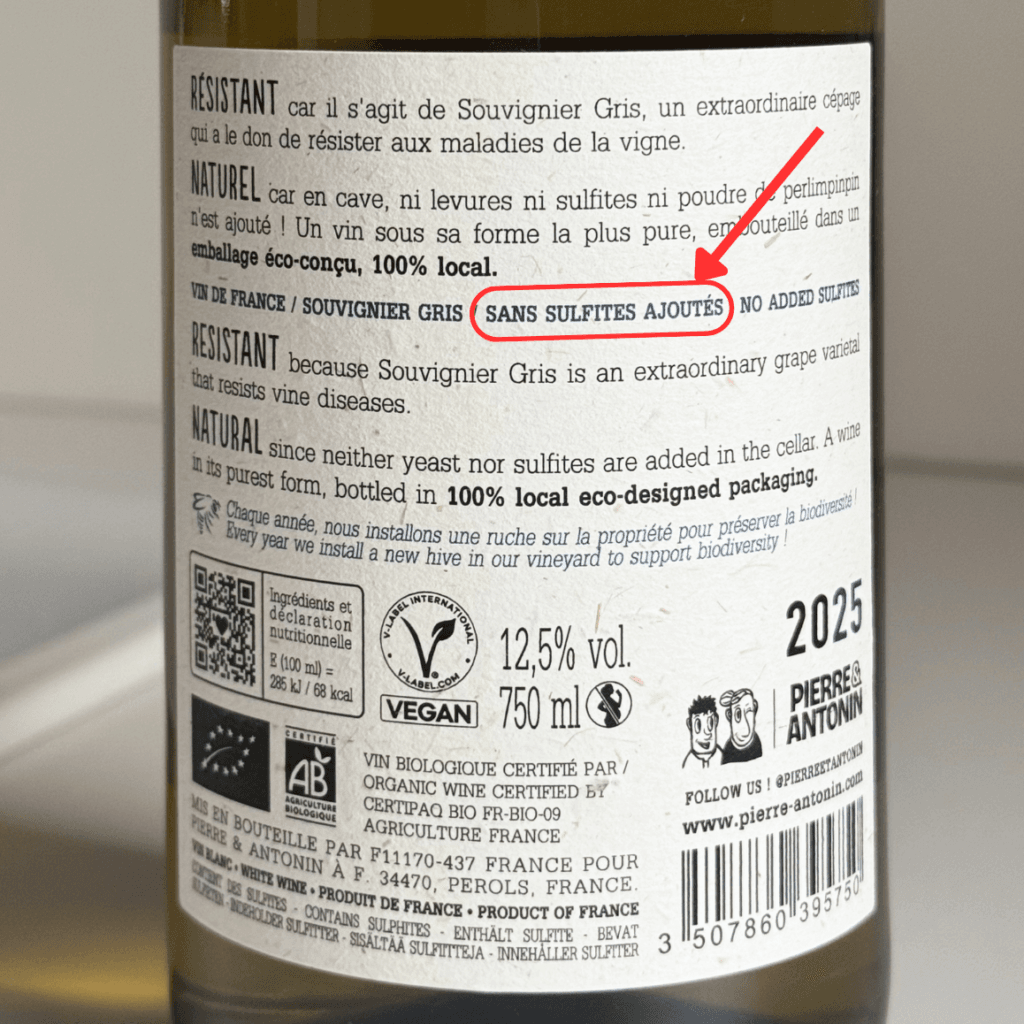
This is particularly the case at Pierre & Antonin, where all wines are free of added sulfites, with an approach based on :
The aim is not to be “sulfite-free” at all costs, but to produce wines that are lively, coherent and easy to digest.
Wines with no added sulphites can offer :
But also sometimes :
It’s a different experience, not better or worse.
In the end, the question may not be “should sulfites be avoided?”, but rather: how do you produce a wine that doesn’t need them?
This is the question that guides our work at Pierre & Antonin.
Live grapes, minimal intervention, and wines with no added sulfites, designed to express their origins as simply as possible.
The news